KRAFT drop ceiling grid
The T‑bar grid that carries the tiles — Nova and Fortis
A suspended ceiling grid is a metal framework of T‑shaped profiles with tiles laid into the openings. The grid hangs from the structural slab on wire hangers, hides the services above and still lets you get to them. KRAFT makes the profiles in two models — Nova and Fortis — and keeps both in stock.
Nova or Fortis — which one to take
Both are always in stock. What differs is the load rating, the width of the exposed face and the colour range. The locks are identical, so you can mix Nova and Fortis in one ceiling: Fortis main runners where the load needs it, Nova across the rest. From below you cannot tell them apart.
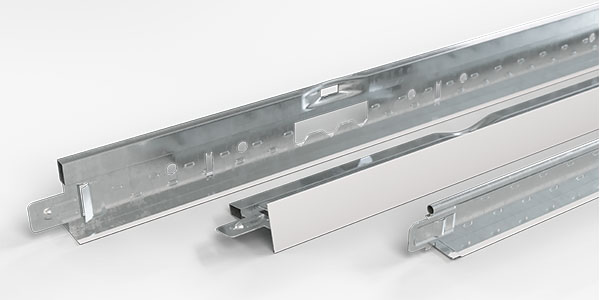
KRAFT Nova
The standard model. 24 mm face, white RAL 9003.
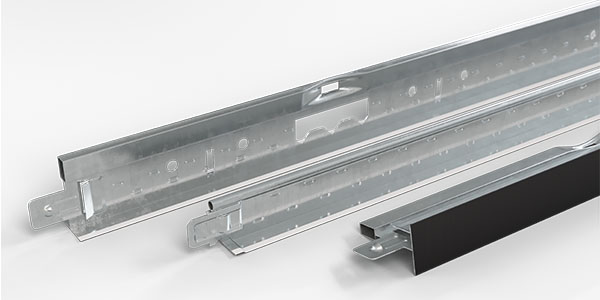
KRAFT Fortis
The heavy-duty model. 15 or 24 mm face, full RAL range.
| Parameter | KRAFT Nova | KRAFT Fortis |
|---|---|---|
| Load capacity | up to 4.5 kg/m² | 7.0 kg/m² · up to 12.0 kg/m² on layouts with extra hangers |
| Breaking load, T‑24 | 216 N | 413 N |
| Exposed face width | 24 mm | 15 or 24 mm |
| Colour | white | RAL 9003 · 9005 · 9006 · 7024 · 8017 · wood finishes · any RAL to order |
| Availability | in stock | in stock |
| Material | galvanised steel, polymer coated | galvanised steel, polymer coated |
| Warranty | 5 years | 5 years |
| Best for | budget projects | heavier loads and design-led work |
Breaking load measured by Instytut Techniki Budowlanej to PN‑EN 13964:2014‑05 over a 1000 mm span. Declarations of performance NR.02/2025/KRAFT and NR.03/2025/KRAFT.
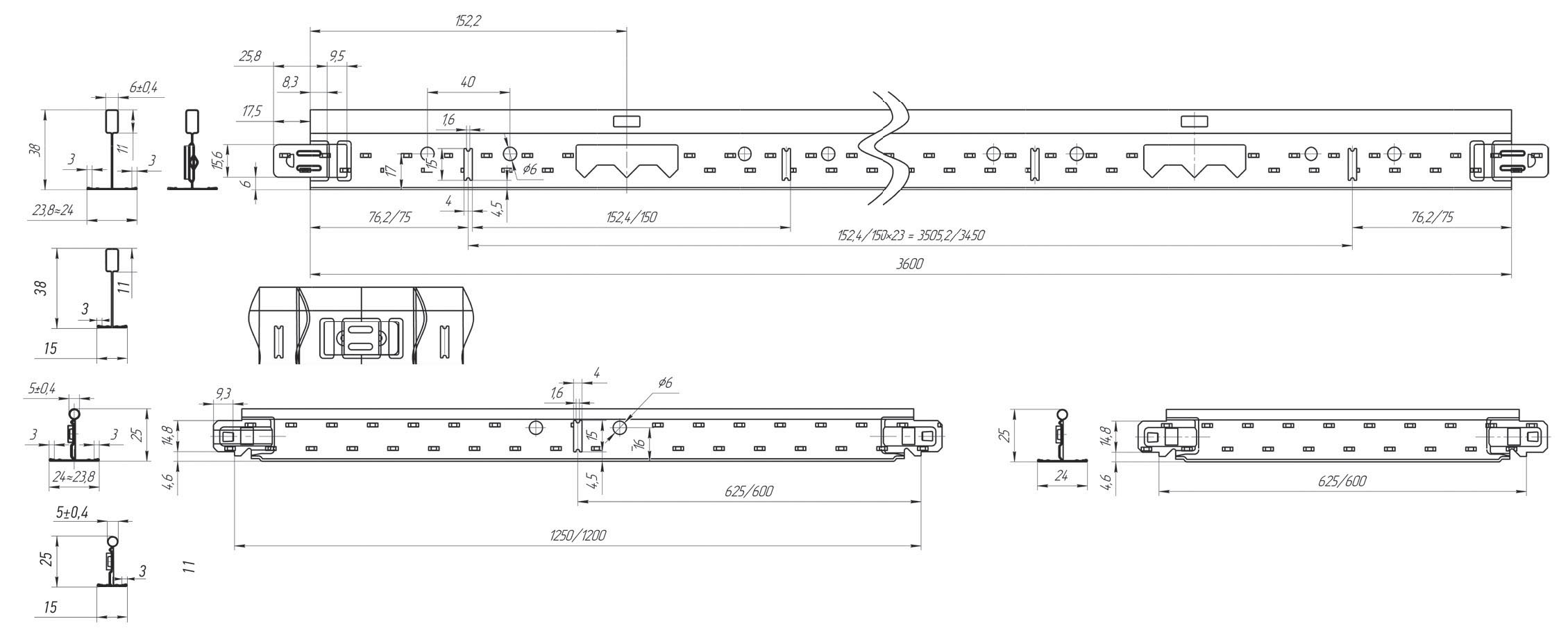
Profile sizes
Special versions to order
- KRAFT HD
- Thicker-gauge profile for heavier loads.
- KRAFT RH100
- Fully coated steel for high-humidity rooms.
Made to order for a specific project. Specifications and lead times on request.
Ask about special versionsWhy steel gauge tells you nothing about strength
Profiles get compared on gauge: 0.19 mm, 0.25 mm, 0.30 mm. It is an easy number to quote and a misleading one. What a profile can carry comes down to the shape of its section, the grade of steel and how ductile that steel is — not how much metal went into it.
Geometry does the work, not mass.
Bending resistance goes up with the square of the profile height and only linearly with wall thickness. A well-designed section carries more using less steel.
Thicker is not stronger.
Steel also has ductility. A thicker but more brittle profile fails sooner than a thinner, tougher one — it does not bend, it cracks.
Thicker steel means a heavier ceiling.
And ceiling weight is load on the building structure — something every engineer is trying to keep down.
Strength comes from the section.
KRAFT profiles are rolled with additional stiffening ribs along their full length. Those ribs, not the wall thickness, are what give the profile its bending resistance — and that is what the European institute measured and recorded in the declarations of performance.
CE marking and EU declarations of performance
KRAFT profiles are tested by Instytut Techniki Budowlanej, the Polish building research institute and EU notified body No. 1488. The test results back the declarations of performance that carry the CE mark under Regulation (EU) No 305/2011.
| Property | Value |
|---|---|
| Reaction to fire | Euroclass A1 — non-combustible |
| Durability class | B |
| Harmonised standard | PN‑EN 13964:2014‑05 |
| Notified body | Instytut Techniki Budowlanej, № 1488 |
| Assessment system | 3 |
| Regulation | (EU) No 305/2011 |
Euroclass A1 is assigned under Commission Decision 96/603/EC as a non-combustible material — no fire testing required.
Declarations of performance
- Fortis T‑15 and T‑24 main runner
- Nova T‑24 main runner
- L‑shaped wall angle 24×19
- W‑shaped wall angle
- System hanger
- Metal ceiling tile
Manufacturer — KRAFT Deckensysteme Poland Sp. z o.o., ul. Nowogrodzka 31/330Z, 00‑511 Warsaw. Declarations issued on 1 August 2025.
What happens to the ceiling in a fire
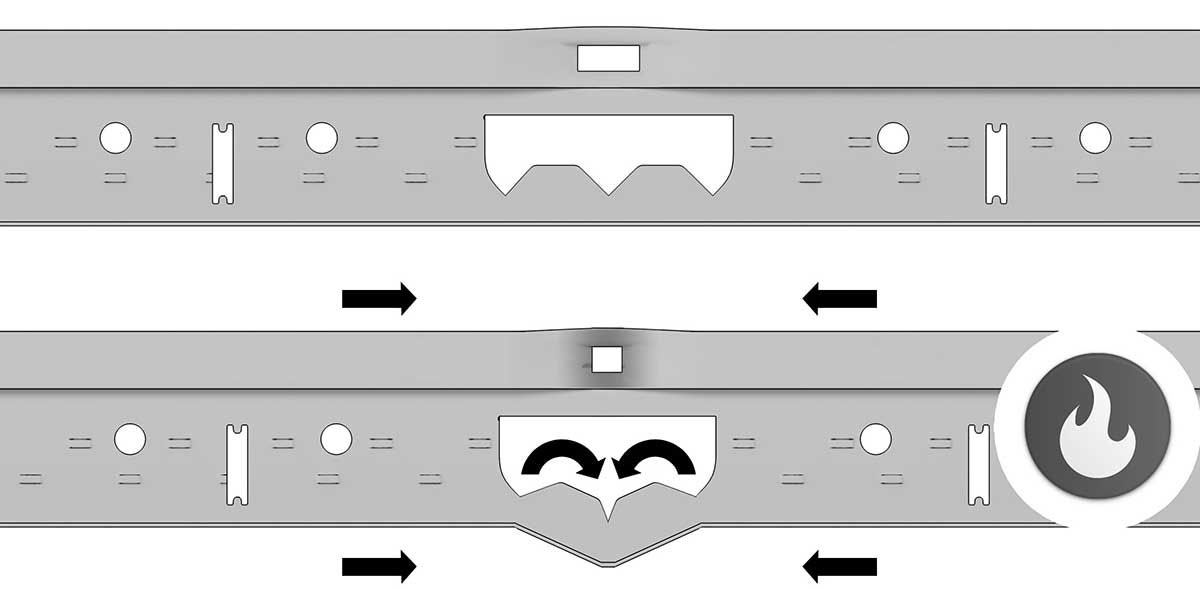
Metal expands when it heats up. In the long profiles of a suspended ceiling that builds stress, the grid distorts and tiles can drop out — at exactly the moment people need a clear way out.
KRAFT profiles have a fire expansion slot — a cut-out that takes up the thermal movement. The profile grows into the slot instead of pushing against the rest of the grid, and the ceiling keeps its shape.
Together with the A1 non-combustible rating, that means a ceiling that neither burns nor comes down.
The grid comes apart and goes back together
On most systems the T‑bar lock is a one-shot fitting: to separate two profiles you have to break it. The KRAFT lock lets you take them apart without damaging anything.
- access to the services without buying new profiles
- reworking a layout and reusing the grid
- taking the ceiling with you when the lease ends
- replacing one area without stripping the whole ceiling
What goes into the grid
| Element | Size |
|---|---|
| Main runner | 3600 mm, 38 mm deep |
| Cross tee | 1200 mm, 25 mm deep |
| Short cross tee | 600 mm, 25 mm deep |
| L‑shaped wall angle | 24×19 mm, length 3000 mm |
| W‑shaped wall angle | 28×30 mm, length 3000 mm · flanges 20 · 15 · 8 · 15 mm |
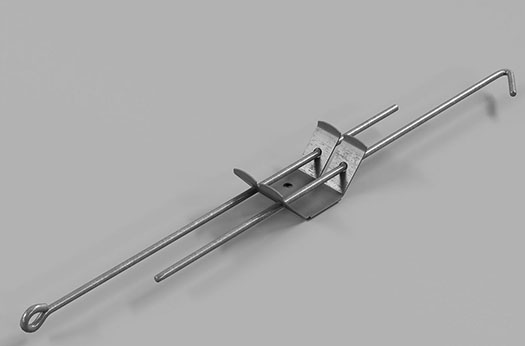
| Butterfly hanger | hook wire, eye wire and spring clip |
| Infill | ceiling tile or GLK open cell cassette |
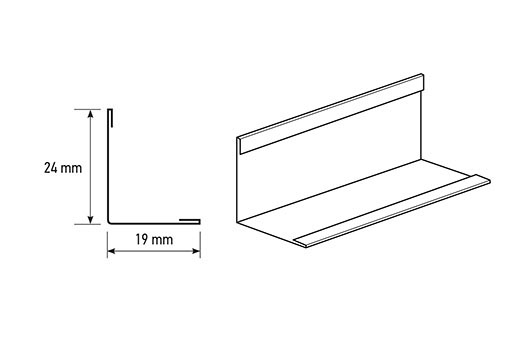
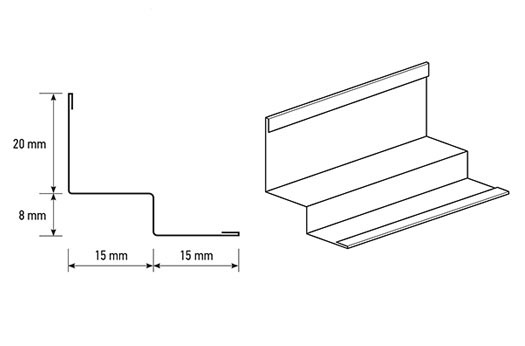
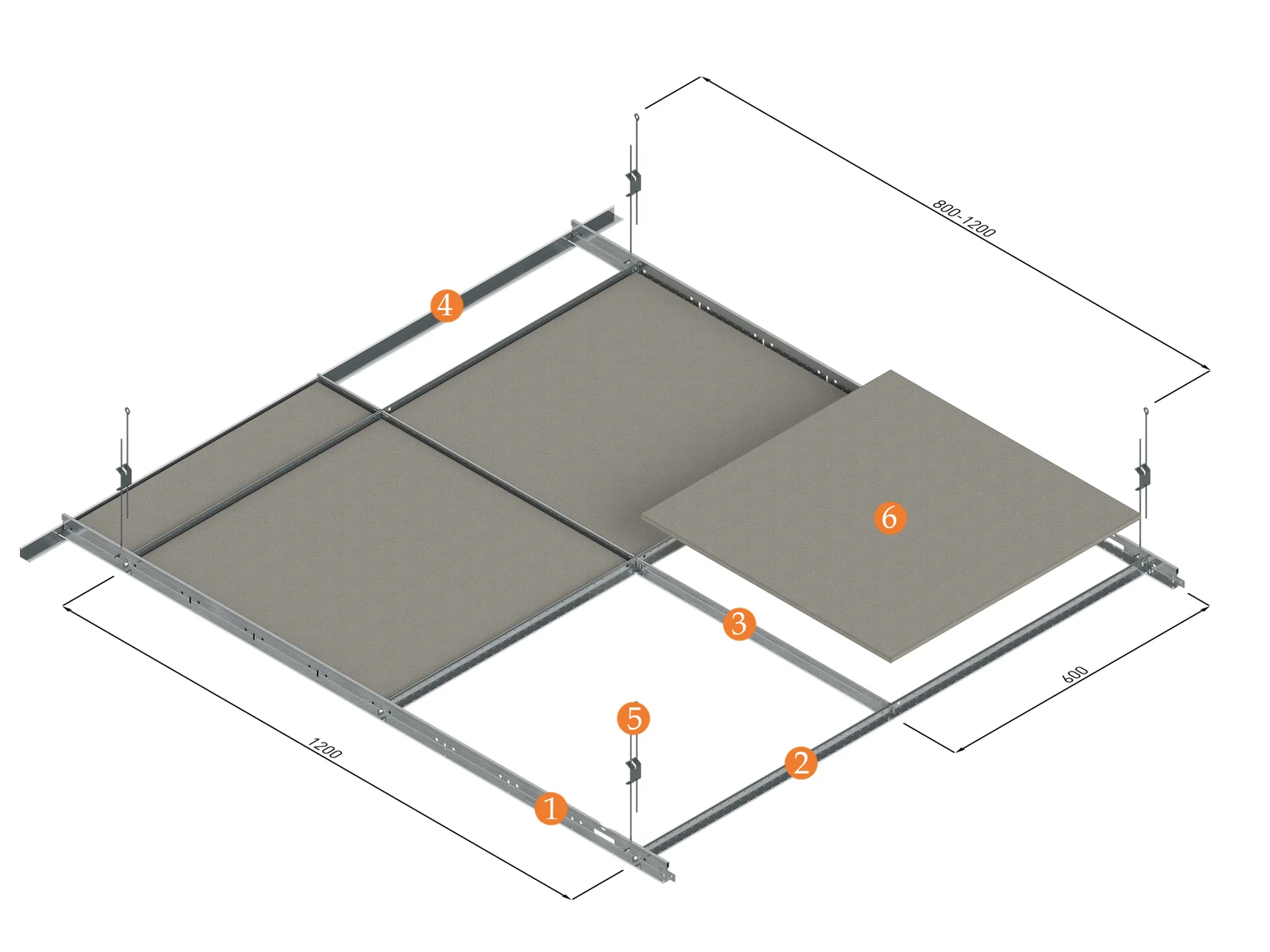
- 1Main runner
- 2Cross tee
- 3Short cross tee
- 4Wall angle, L or W
- 5Butterfly hanger
- 6Infill
What the grid can carry
- mineral acoustic tiles
- KRAFT metal tiles — Euroclass A1, declaration NR.01/2025/KRAFT
- GLK open cell cassettes — same system, same grid
Eight layouts for different tile sizes and load ratings, with quantities per m², are on the installation page.
What a suspended ceiling grid is made of
The system goes by several names — suspended ceiling grid, drop ceiling grid, T‑bar ceiling, lay-in ceiling. They all describe the same thing: main runners at 1200 mm centres, cross tees between them, and tiles laid into the openings from below. What changes between manufacturers is the lock design on the profiles, and that is what decides compatibility.
Can I swap another manufacturer's profiles for KRAFT in an existing ceiling?
No. From below every T‑bar looks much the same, but each manufacturer has its own lock design, and profiles from different systems will not clip together. It is the whole grid or nothing.
What about light fittings?
Those are different. KRAFT G‑LED mounts on other manufacturers' grid ceilings too — it fixes to the profile with double-sided tape and does not care about the lock design. So you can put KRAFT lighting into an existing grid from any manufacturer.
Light fittings in a T‑bar ceiling
Any fitting over 250 g needs its own hangers back to the slab — one to four of them, depending on size and weight. That is extra hardware and extra labour on every single point.
KRAFT LED is the exception. These fittings need no extra hangers — they sit on the grid's own structure.
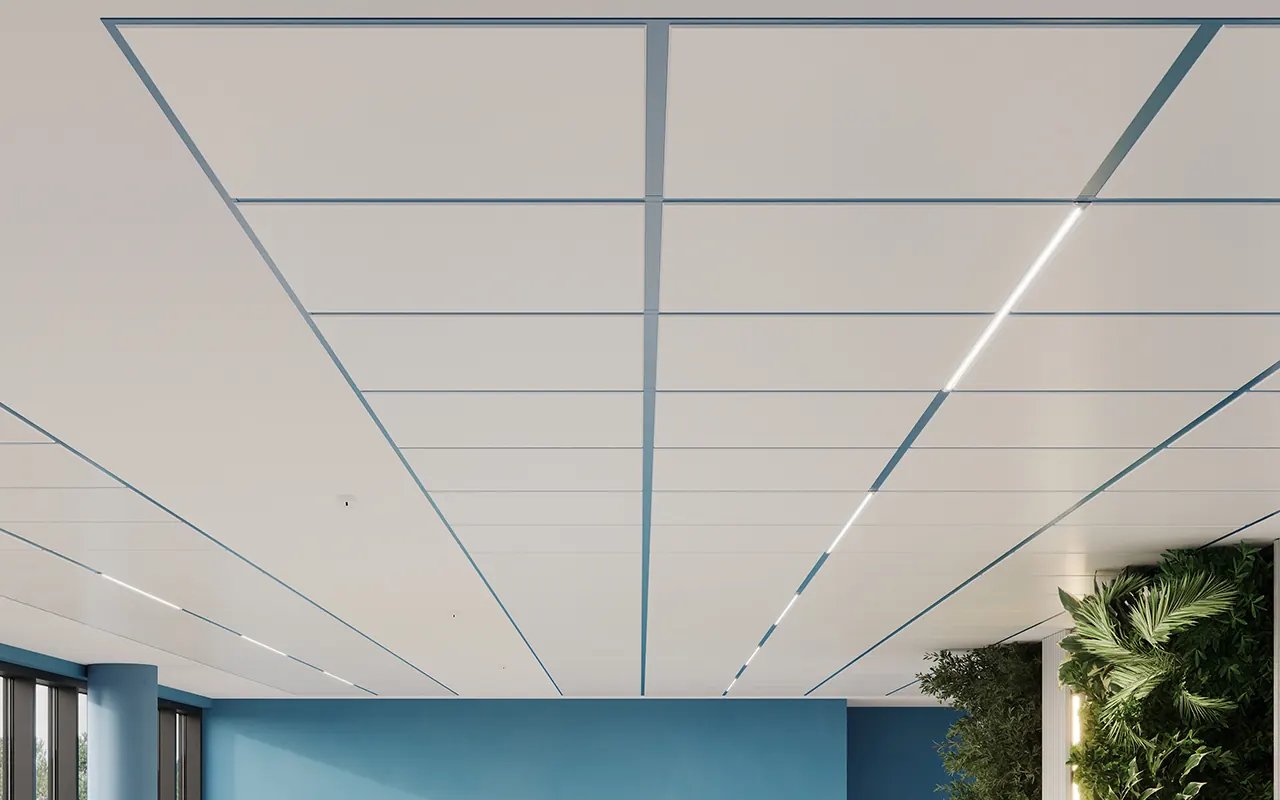
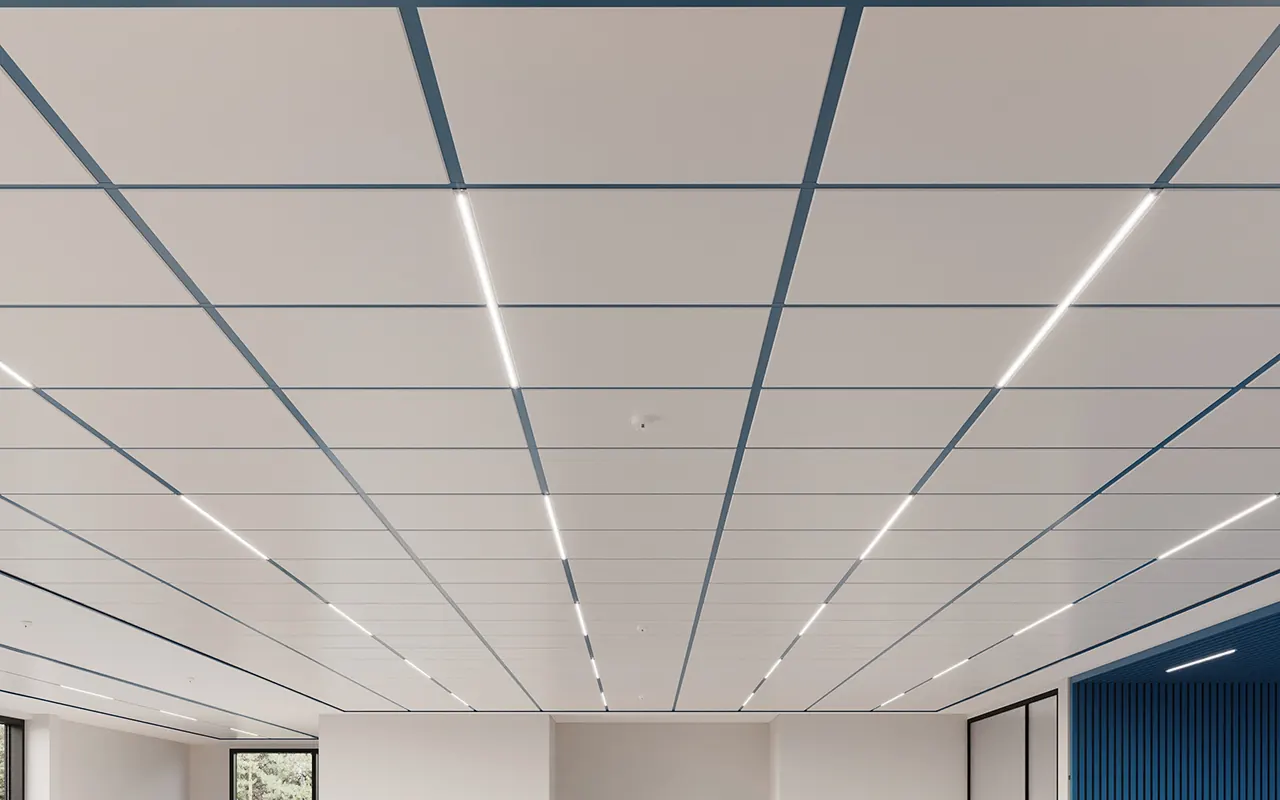
KRAFT T‑LED is a Fortis profile with LEDs built in. It replaces an ordinary T‑bar in the grid, so it goes into the material take-off from the start rather than being added afterwards.
Frequently asked questions
A suspended ceiling grid is a metal framework of T‑shaped profiles hung from the structural slab, with tiles laid into the openings from below. You will also see it called a drop ceiling grid, a T‑bar ceiling or a lay-in ceiling — all the same thing. KRAFT manufactures the profiles for this system in its own plants.
Nova is rated to 4.5 kg/m². Fortis takes 7.0 kg/m² on the standard layout and up to 12.0 kg/m² on layouts with extra hangers. Fortis also comes in two face widths, 15 and 24 mm, and in RAL colours. The locks are the same on both, so you can mix them in one ceiling.
Every manufacturer has its own lock design and profiles from different systems will not clip together — it has to be the whole grid. Lighting is different: KRAFT G‑LED does mount on other manufacturers' grids, because it fixes with tape and does not rely on the locks.
The profiles are Euroclass A1 to PN‑EN 13964:2014‑05 — non-combustible. They also have a fire expansion slot: a cut-out that absorbs thermal movement and stops the ceiling distorting as it heats.
A KRAFT suspended ceiling carries 4.5 to 12.0 kg/m², depending on the profile model and the layout. Nova takes up to 4.5 kg/m². Fortis takes 7.0 kg/m² standard and up to 12.0 kg/m² with extra hangers. Breaking load measured by Instytut Techniki Budowlanej: 413 N for Fortis T‑24, 216 N for Nova T‑24.
The take-off depends on the layout. For the common 600×600 mm tile layout you need 0.232 main runners of 3600 mm, 1.4 cross tees in each direction, 0.7 hangers and 2.78 tiles per square metre. The full table for all eight layouts is on the installation page.
The grid is made up of 3600 mm main runners, 1200 mm and 600 mm cross tees, a 3000 mm L or W wall angle and hangers. Tiles drop into the finished grid — mineral, metal or GLK cassettes. Profiles join by their locks, so no cutting and no welding.
It is the system hanger that ties the grid to the structural slab. It has three parts: a hook wire, an eye wire and a spring clip — the clip is what gives it the name. The spring lets you adjust ceiling height after installation: you squeeze it with your fingers. The hanger carries its own European declaration of performance.
The L angle is the standard choice and suits square‑edge tiles. The W angle is for tegular tiles: it brings the tile face flush with the T‑bar, with no step at the wall. Both come in 3000 mm lengths, are counted off the room perimeter and carry separate declarations of performance.
For ordinary fittings, yes — one to four, depending on size and weight. KRAFT LED is the exception: it sits on the grid's own structure and needs no extra hangers.
Nova and Fortis are always in stock. The HD and RH100 special versions are made to order.
We will price the bill of materials for your project
Send us the floor area and the type of space — we will pick the profile, the layout and work out the full take-off.